In industrial environments, ergonomics teams are under growing pressure to do more with less. Many programs are volunteer-led, under-resourced, or stretched thin across multiple responsibilities. Even when seasoned teams identify risks and provide expert recommendations, those insights are often overlooked — draining both momentum and morale.
This isn’t a new story, but it’s one we can rewrite.
How AI and Computer Vision Are Changing Ergonomics
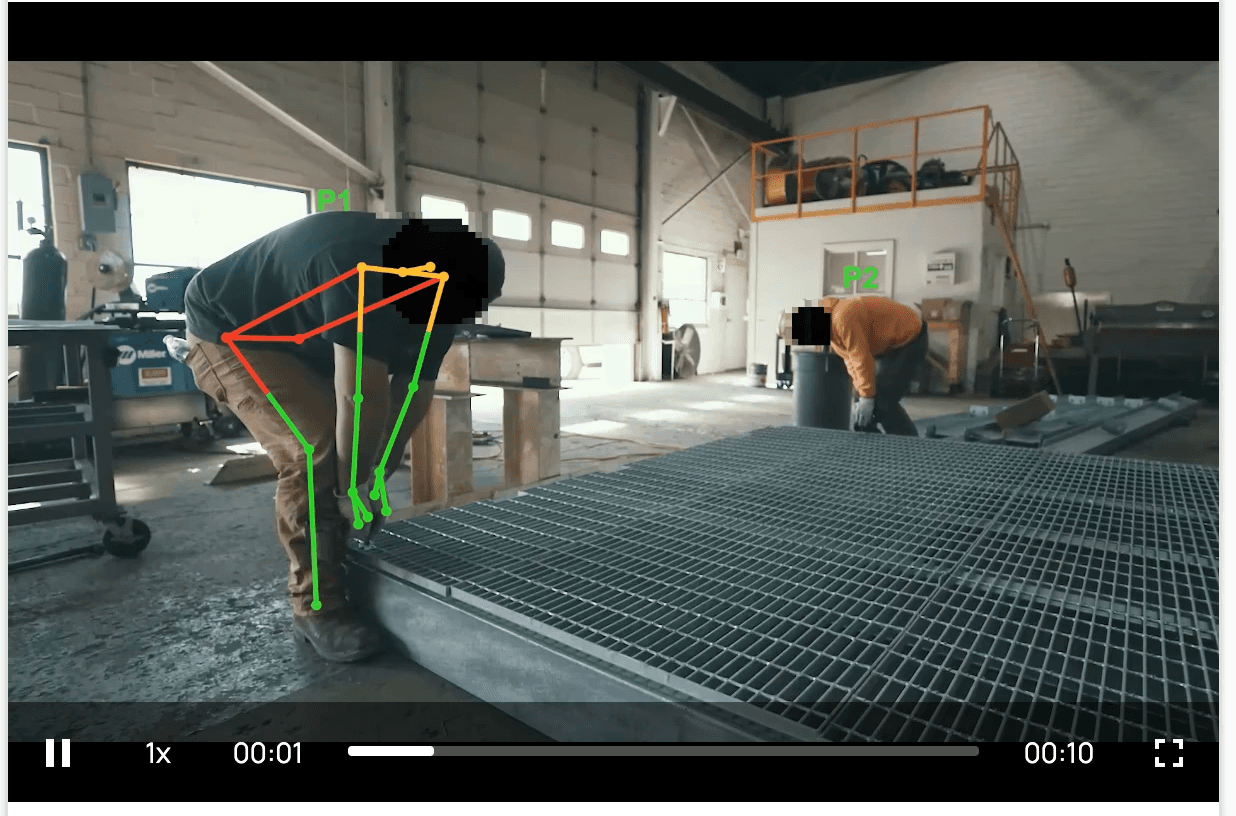
Artificial Intelligence (AI), particularly computer vision (CV), is creating a new path forward for ergonomics. These technologies are helping organizations move beyond reactive posture checks and compliance audits toward strategic, data-informed ergonomics programs that drive real change.
At its core, AI removes subjectivity from ergonomic evaluations. It brings speed, consistency, and accuracy to what was once a slow, manual process. What used to take days can now happen in minutes — all while maintaining scientific rigour and repeatability.
Supervisors can capture short video clips without needing specialized training. The AI system then analyzes posture, calculates risk scores, highlights root causes, and validates improvements automatically. This compressed analysis timeline allows ergonomics teams to spend less time collecting data and more time solving real-world problems.
AI as a Partner, Not a Replacement
AI is not a substitute for human expertise — it’s an enhancer.
The value of AI lies in amplifying ergonomists’ professional judgment, not replacing it. By backing intuition with objective data, AI strengthens decision-making and helps teams spot risks that might be missed in real-time observation.
When ergonomics programs use AI to augment human insight, they improve both accuracy and efficiency — unlocking opportunities for proactive injury prevention and measurable safety improvements.
Breaking Down Silos: Integrating AI with Safety Systems
AI and computer vision tools can also be integrated across EHS departments and safety platforms. When ergonomics data connects with broader environmental, health, and safety (EHS) dashboards or incident-tracking systems, everyone starts speaking the same language.
This unified data view helps leadership identify the highest-risk areas, prioritize interventions, and allocate resources more effectively. It also reinforces ergonomics as a strategic business enabler, not just a compliance requirement.
Building Trust Through Transparency
Adopting AI in ergonomics isn’t only about technology — it’s about trust.
Employees may worry that cameras are being used to monitor performance. Managers may question the accuracy of motion capture results. To overcome these concerns, successful programs pair strong technology with clear communication.
They:
Involve employees early and explain the purpose behind data collection.
Use blurred video options and percentile averages to protect privacy.
Show side-by-side comparisons of ergonomic improvements to make results tangible.
Beyond messaging, trust depends on transparency. When the data and algorithms are open, accuracy can be independently verified, and teams understand how the system works, and confidence grows. It’s not just about what AI says — it’s about showing how and why it works.
The Future of Ergonomics: Smarter, Scalable, and Human-Centred
Looking ahead, AI-driven ergonomics will continue to evolve. New developments in visual language models (VLMs) and large language models (LLMs) will make these systems faster, smarter, and more integrated with safety platforms.
However, progress only matters when it delivers real-world impact. The difference isn’t in the model — it’s in the method.
A well-designed implementation process — one with proper training, documentation, and a clear purpose — transforms AI into more than just a tool. It becomes a core part of how organizations measure, improve, and sustain safety performance.
The Road Ahead
The question is no longer whether AI belongs in ergonomics — it’s how to build systems that make it work consistently, responsibly, and at scale.
The future of workplace safety depends on integrating these tools into the core of how organizations protect people and enhance performance — not as experimental add-ons, but as essential infrastructure for the modern workforce.
How Inseer Is Changing the Game
At Inseer, we’re redefining what’s possible in ergonomics by putting advanced AI and computer vision tools directly into the hands of safety professionals. Our platform turns ordinary workplace video into actionable insights — highlighting posture risks, quantifying movement, and validating improvements in minutes, not days. By eliminating guesswork and empowering teams with objective, repeatable data, Inseer helps organizations shift from reactive assessments to proactive, data-driven safety programs. The result is a smarter, faster, and more transparent approach to ergonomics — one that connects human performance with measurable business outcomes.